Showing posts with label charleston. Show all posts

Wednesday, 18 May 2016

Fini

Hurrah, my dissertation is submitted!
Now I await my judgement.


Over summer I aim to condense these 10,447 words into a shorter article with an aim to getting it published. I'm hoping this will generate more blog posts.

I've recently been corresponding with Jeffrey Green (http://www.jeffreygreen.co.uk/), a British historian who has studied black music in Europe, and written several articles on The Jenkins band which I used in my dissertation, as well as a biography of Edmund Thornton Jenkins. His insight has come too late for use in the above work, but he has been very encouraging and complimentary!

His website is fascinating and contains photographs and research he has compounded over the years, it is well worth a visit. I used some of his information on the Jenkins bands in my dissertation.

In other news I am currently less than two weeks away from finishing my degree, and trying to decide between Sheffield, Newcastle, and Northumbria University's to undertake a Masters in History. If anyone has any advice please get in touch, this decision is proving tough!

Emily x


Sunday, 22 November 2015

The gender balance in Carolina's orphanages

I've been spending today doing some research into orphanage institutions in the South between the 1890s and 1920, and found some partial answers to questions I have had relating to gender in the orphanages that arised from my observations of studying the Jenkins orphanage.

The questions I had were:

Whether there were as many young orphan girls in South Carolina as there were boys, and if they were in the orphanages why weren't they mentioned much? And if there were not as many, why, where did they go if they left the state, and how typical were the ratio of girls to boys in similar orphanages...?

This morning I was reading Peter Bardaglio's book Reconstructing the Household (1995) and found a reference to an 1896 statute in Tennessee which stated:

''...Said board of managers, directors or trustees may, at their discretion, require the parents of such indigent children to surrender all right and claim to the control of them, and to consent for the said asylum to provide homes for them… for the purpose of caring for and educating them, teaching them trades and household duties generally.''


Statues like these were introduced during the 1890s around the South, giving orphanages the right to take children away from their family if the guardians were deemed unfit to care for them.

I knew I had to follow this up, and find some more primary source material to help me answer my questions, though when first looking I wasn't particularly looking for gender-related evidence. I managed to find a range of documents on http://docsouth.unc.edu, unsurprisingly mostly relating to North Carolina as the website's material comes primarily from the libraries at the University of North Carolina at Chapel Hill.

Two of them however were 1861 sources which discussed the (white) Orphan House in Charleston. The N.C documents consist of annual reports of both black and white institutions between 1899 and 1911, along with different pleas for donations, such as the one pictured below.


Image from 1939 pamphlet 'My Future Depends Upon You!' at http://docsouth.unc.edu/nc/myfuture/myfuture.html


The Oxford Orphan Asylum was North Carolina's first orphanage, opened in 1873, and took in white children. Ten years later the The Colored Orphan Association of North Carolina was opened in the town of Henderson in August 1883.

The Charleston Orphan House was opened much earlier in 1790, showing South Carolina was way ahead of its neighbor state in provision for poor and destitute children.

The Jenkins Orphanage band, however, South Carolina's first orphanage for black children, was opened in 1891: 8 years after North Carolina's first African American orphanage.

Studying these institutions did not give me direct answers to all of my questions, but certainly gave me a clearer picture of some comparisons that can be drawn between Charleston and elsewhere in the South.

From examining the documents it is apparent that in the case of the Colored Orphan Asylum located at Oxford, N.C, the ratio of boys to girls was actually 2:3 between 1899 and 1911. This rather suggests that orphanages were somehow more inclined to take female children in than male children. In comparison to the Jenkins orphanage, this is surprising as it is the male children that are referenced far more in advertisements and newspaper articles. It is likely that the Jenkins orphanage in the neighboring state of South Carolina followed a similar pattern of taking in more girls than boys, though clearly the girls were less talked about by outsiders.


In the white orphan house in Charleston, the By-laws of the institution in 1861 say that $150 is given annually to the clothing of the boys, and that $80 is given by the City Council 'for the purpose of aiding the object of the State Legislature in the provision made for the education of the boys of this Institution.' (http://docsouth.unc.edu/imls/orphan/orphan.html)

Interestingly it is 'boys' that are mentioned here; no such provision for girls are listed, although girls are talked about elsewhere in the document. Reading the document through the language is very gendered: nearly twice as many references are made to boys than girls.

Strikingly, there is a significant different between the state provision of the North Carolinian and South Carolinian black orphanages. ‘The Legislature of North Carolina in the year 1891 granted an annual appropriation of $1,000 to the Asylum; in 1893 it was increased to $1,500; in 1895 to $3,000; and in 1897 the Legislature raised it to $5,000.' Yet I have not found evidence that the state of South Carolina donated to the Jenkins orphanage, except that the city of Charleston itself gave only $1,000 annually to the orphanage. 1912 donations from the North and collections by the Jenkins orphanage band exceeded donation from the city by ten times.

Yet the Jenkins bands were not the only orphanages sending out travelling choirs - the white Oxford Orphan Aslyum in North Carolina sent out groups of three or four children during the summer accompanied by teachers to give singing performances throughout the US to raise funds. It is quite definite that the sort of music the white children sang was very different to the rowdy and innovative brass bands of the Jenkins children!

Common goals of the documents show these orphanages were seeking 'racial uplift', to change the accepted view of African Americans as criminals into a more positive one. Ideas of education, apprenticeship and training are clearly in line with Booker T. Washington's promotion of industrial and vocational education for southern African Americans when he opened Tuskegee University in 1881, where students were expected to work hard and have skills in areas other than academics. This certainly compares to the orphans' industrial work on the farm opened by Reverend Daniel Jenkins alongside his Orphanage in Charleston.

Another common theme between these white and black orphanages is of course religion, and the message that helping the orphans is what God wants is seen in many references to Jenkins Orphanage. The 1900 annual report of the Colored Orphan Asylum in Oxford was organized by the Wake Baptist Association and the Shiloh Baptist Association, and had originally been named "The Colored Baptist Orphan Association of North Carolina," Soon the name was changed and the religious association was removed, so that 'when the doors of the Asylum were first opened . . . the most needy colored orphan children were invited to come, regardless of denomination"’ (http://docsouth.unc.edu/nc/asyl1900/asyl1900.html)

These reflections do not answer all of my questions on the gender balance in the orphanages, but it is clear that while there are clear similarities between orphan houses in North Carolina and South Carolina at the turn of the century, there are also some marked differences. Girls appear to be better represented in the North Carolina orphanages, both black and white. The ratio of black children in orphanages in North Carolina were two girls to one boy, though I am not much closer to answering why the representation is lower in material on the Jenkins Orphanage.


Image courtesy of http://avery.cofc.edu


The question of gender in southern orphanages during the Jim Crow era is something I will of course carry on researching, and I will hopefully be able to update my blog soon with more answers!

Sunday, 27 September 2015

Charleston's real 'Porgy'

To any readers who may have heard of American composer George Gershwin, or indeed anyone who has ever heard the song 'Summertime' (hopefully everyone), I've discovered some really interesting things about the opera Porgy and Bess whilst doing this research on Charleston.

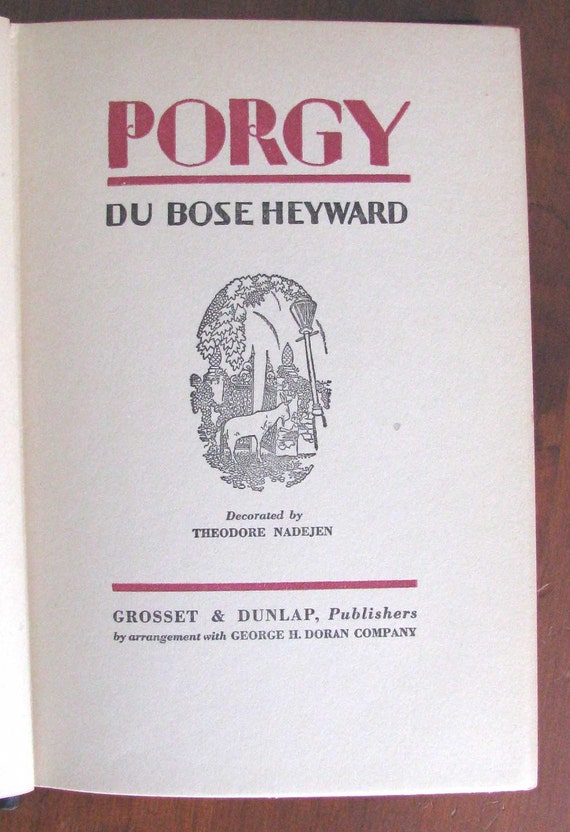
Gershwin's famous opera is based on DuBose Heyward's novel, Porgy, a novel set in 1920s Charleston which traces the lives of poor black Charlestonian's. Neither the play or the opera was performed in Charleston until 1970 because of the racial climate which forbade it.


The main character Porgy is based on the black crippled beggar Sammy Smalls who was arrested in 1924 but later released. I've always been a fan of the songs and overture of Porgy and Bess, which now means more to me having visited and studied the city where it was originally set. And The Jenkins Orphanage Band were the band in Charleston that Heyward describes in his novel (I understand the passage is copyrighted so I cannot produce it here).

I've also just learnt that the song 'Summertime' is actually about the feelings of the survivors from the devastating hurricane of 1911.

After world war one, when the rest of the nation was busy building themselves as modern progressive cities, Charleston was alone in the South for wanting to look backwards and preserve its past. The city has always been proud of its heritage, and is willing to accept, and publicize, the large part it played in the slave trade. Walking past the swaying palmetto trees on the seafront and the rich southern planters homes, and comparing them to the rundown parts of Harleston village and the derelict county jail next to the original home of the orphans, you can almost see Sammy begging on the side of the street with his goat cart, and see the disgust of former slave owners adjusting to a world in which cotton and rice were no longer king.
.

The county jail:


Below: a few examples of southern planter homes


And, seeing as we're talking about Heyward, he is coincidentally a descendant of one of only four South Carolinian signers of the Declaration of Independence (Thomas Heyward Jr.). Joseph and I signed a version of the document in the 'Old Provost and Exchange' building, and also got to dress up, which I suspect was really an activity for small children. So naturally, photographic evidence was needed.


Tuesday, 15 September 2015

Saved from the chain gang

So this post isn't exactly what I said my next post would be (a musical analysis of the Jenkins Orphanage band). This is because I haven't had chance to look at enough to write a blog post on, and because I've been busy with other stuff which I think is allowed.

I start my third year in less than two weeks now, I am so excited to get back to Newcastle and see what's on the horizon for me this term. I love Sheffield but most of my friends have gone back to their own University's now and the city is a bit bleak here at the moment! I am going to be doing a work placement this year in the Great North museum where I already volunteer as a library assistant in their wonderful history collections, and am running the administration side of Journey to Justice (as a temporary role; they were struggling to find someone so I said I would try my best alongside my studies and see how I got on.) I am also the new Academic officer of Newcastle University's History society for 2015/16, which involves being the principle contact between lecturers/staff and the society, and planning academic events and talks.

So I have a few things I'll be balancing this year, but I guess that's normal for me. Anyway, the main aim of the blog is my research, which I have been working hard on for the past few days. Proof of me in action (yes it involves highlighters and a magnifying glass) -


So basically I am currently going through all the newspaper articles/advertisements I printed out in the Library of Congress and Charleston's 'Avery Research Center', and making notes on the main themes, how they present the Jenkins orphanage band, who is writing, etc. I've found some really interesting information which highlights the social and economic climate of the US south at the time, and indeed the poor opportunities and help available for black people.

The collection of newspaper articles I have date between 1895, and 1936, though I am concentrating mainly on the 1890s up until around 1920. It is hard not to get sidetracked to look at later years, when so many of the musicians went on to perform for Count Basie, Duke Ellington, Erskine Hawkins and a score of other famous musicians and bandleaders in the big band era. But  that is a whole other research project (and also the subject of the anthology Dr Karen Chandler at the Avery Research Center is currently writing).

(The Avery Research Center today. This building used to be the Avery Normal Institute, was founded at a similar time to the Jenkins Orphanage and was also a great school that taught many of South Carolina's musicians).

A great many of the articles are advertising concerts the band were performing in, and entry prices to these range from 50c to nothing. The geographical range of these advertisements are huge - from Maine and Massachusetts, down the east coast to Florida, across to Tennessee and even as far west as Utah. I also have a few articles from London, UK. Doubtless the band also visited many other cities I haven't yet found records for. Surprisingly I have found very limited sources from Charleston newspapers. My main knowledge of their focus is from quotes from The Charleston News and Courier printed in other newspapers. The majority of articles that mention the Jenkins orphanage band are from northern newspapers - the economic climate of the south after the Civil War was in very bad shape even after reconstruction, and Jenkins probably took the orphans north because that was where most of the money was.

A common theme across the time period is a plea for money and aid to help the 'little destitute orphans.' Language to shock and encourage people to sympathize with the children's cause was often used, such as in a letter from Reverend Daniel Jenkins himself to a New York newspaper in 1897 which stated 'we must raise the remainder [of the funds needed] or let the children die.' Mentions of starvation and illnesses would doubtless have gotten attention and money from mothers/parents etc and those with money to spare.

Many references to Jenkins having saved children from lives of crime and violence are used, and something I found interesting but perhaps not surprising is that in the few relevant women's magazine articles I have read, the godly work of Jenkins and his charitable and humble personality are emphasized, playing on the contemporary view of women as having voluntary and charitable associations, and as mothers with children's best interests at heart.

The only photographs of Jenkins or black musicians that appear in any of the newspapers are in black publications, as might be expected. The African-American newspapers also make little mention of the race of the band- it is probably presumed by the readers that those discussed are black. Yet nearly all of the newspapers published by white people make it clear that Jenkins is a 'negro' and the children are 'darkies' (Lloyd's Weekly Newspaper, London, England, 8th September, 1895), sometimes pointing these out in the headline to catch people's attention.

Jenkins is throughout all of the newspapers portrayed as a very honest, hard-working and good man. Though in some cases the impression is given, such as in Chicago's The Daily Inter Ocean on the 11th July, 1895, that he is a 'good' black and is improving the view people have of his race. Many references are drawn to the 'betterment of his race', or 'the awful conditions of the colored brother of the south' (The Daily Picayune, New Orleans, 11th June 1897), pointing out that black people in post-reconstruction had a much harder day to day life than white people did.

The band's music is hugely praised, and there are many review articles to be found written by both white and black journalists, documenting the names of items, performers, and crowd impressions of the concerts. They are favorably compared to other 'pickaninny bands', and even the Home for Colored Waif's in New Orleans which Louis Armstrong grew up in.

There is no doubt that the orphanage boys and girls were widely loved and praised throughout America and Europe, which just leaves me with a slightly bittersweet taste in my mouth. It is of course wonderful that these talented black children were so widely accepted and their concerts well attended, and yet their parents and other African Americans were at the same time being penalized, trampled on and ignored, implying that only faith, good Christian charity work as was being provided by Jenkins and his administration, and money, could raise their children up from the bottom of an unequal and unjust society and give them a better life than the alternative of the jail or chain-gang could. The children should not have needed 'saving' in the first place. I would like to think that my conclusion would be otherwise but my research on race relations is telling me that learning music was,intentionally or coincidentally, a way out of the negative connotations of being black, and unfortunately not everyone had that opportunity.

I didn't mean to end on such a pessimistic note! Have a nice photograph of the band, courtesy of the Avery of the Avery Research Center for African American History and Culture, College of Charleston, Charleston, SC (apologies for the quality, it's a photocopy of a photocopy).


Wednesday, 9 September 2015

Showmen

I am so happy to say that I finally have permission to use some of the photographs of the band!

I'm still in the process of gaining permission for one or two of the best ones; and unfortunately I can't get permission for my personal favourite photograph which is very clear, but obviously understandable as the collections at Avery are still largely unprocessed.

Most of the ones I have are undated, and nearly all come from the Charleston Jazz Initiative collections in the College of Charleston (including the one below).

So here is just a taster of one image of the the Jenkins Orphanage Band from the Anglo-American Exposition during 1914...


As is seen here, the conductor was usually always a small boy who often performed tricks such as cartwheels whilst the band played. The band were taught to be great showmen and knew how to attract an audience!

King George V was so impressed with the band that he requested a private concert while they were in London, but unfortunately this had to be called off after Great Britain declared war on Germany.

Tuesday, 25 August 2015

Piecing the story together

I'm spending some time sorting through my notes and have come across a few things I wrote down which I wanted to share here.

Firstly a snippet from a 1989 newspaper article; the Charleston Messenger on Saturday 7th May reported about the new industrial buildings on Jenkins' farm ''where criminals and little vicious boys can be put to work for themselves and be made to earn their own bread by the sweat of their brow... it makes one feel that God is conducting the whole affairs of the Jenkins Orphanage'' - sadly a view reflected by many white people at the time, and ironic that the Reverend Jenkins himself was such a religious man and strove so hard to give these children a better chance in life than the hand they'd been dealt.

Jenkins was a very humble man and thanked 'good white and colored citizens, one and all' for their help in his achievements in the orphanage. One thing I came across in several different articles/reports was his concern for children's lungs and their health: he thought, and was probably correct, that children learning wind and brass instruments would strengthen their lungs and so make them less susceptible to lung-related illness.
'I promised God when I started out to build an orphanage that I would give the boys and girls plenty of corn bread and molasses, and other things whenever I could, and make them work for a living.' (Charleston Sunday News and Courier, May 16th, 1926). Nobody can deny that he achieved these promises. In 1895 the orphanage was damaged in a storm and Jenkins took some band members North to raise funds for repairs - he said 'I felt that I had rather die than return to Charleston without the money to cancel the debt.' (John Chilton, A Jazz Nursery: The Story of the Jenkins' Orphanage Bands).

If anyone has a Time magazine subscription, there is a great article on Daniel Jenkins here from August 26th, 1935 - http://content.time.com/time/magazine/article/0,9171,748914,00.html

I don't unfortunately so can't read it again, but I was able to read a photocopy of the article in the Avery research center in Charleston.

In the same year the Times article was written, an Associated Press sports writer called Edward J Nell wrote an article which again paints a clear picture of the orphans. He said 'a negro jazz band rolled up to Max Baer's camp at Speculator the other day and insisted on serenading him... there were fifteen of the funniest looking darkies you ever saw. They were from the Jenkins Colored Orphan asylum in Charleston, South Carolina... the truck was coming apart and the wheels were falling off... the negros played their hearts out. They were very happy.' - another stereotypical, mildly but probably unintentionally racist account written by a white man which portrays the poor conditions the orphans live in, but also the way they had been brought up by Jenkins to be grateful for what they had.

Chilton described Daniel Jenkins as a very striking man over six feet tall with a blue-black complexion.  He called the children his 'black lambs' which has been used in many articles and references to the orphans.

Jenkins' life was not an easy one, as anyone might imagine. He was arrested in London in 1895 for creating a spectacle of himself by bringing over an all-black orphan band to play in the streets, and was accused of illegally exploiting children. (Sometimes these old laws surprise me how they could arrest a man for 'exploitation' and yet not too long before kept slaves themselves. The age-old irony.) His wife Lena Jenkins was very ill by the time a new secretary, Eloise Harleston, came to travel with the band as a secretary and publicist: a scandal was created when Eloise became pregnant with Jenkins' baby. She had to move to the UK to have the baby, a little girl named Olive. Eloise and Daniel married in 1912 after his wife Lena passed away. The band were also stranded in England for several months in 1914 when the first world war broke out and travel in and out of England was temporarily halted. Jenkins ended up lending some money to some fellow Americans who could not get home either as they were not allowed to use their foreign paper money until wartime relations settled.

And then there were scandals within the bands themselves: one member was imprisoned in 1919 after stabbing another man in the neck. Some very touching stories from the orphanage have been told by John Dowling, who had his hat spat in by a white man when he offered it round for collections. He remembered ''Now, we were schooled in every way and geared up for anything that might happen. I can remember the tears coming in my eyes as I tried not to cry. But I took my handkerchief, wiped out my hat, and turned to walk away. The man reached out and tugged my coat. When I turned around he put five dollars in the hat.''

I've found so many more of these stories and memories that give glimpses into the lives of these orphans, and of the music they they charmed so many hearts with.

'Born perhaps of the dire conditions in which they found themselves in, the orphans' music was infused with a kind of soulfulness that was not lost of the casual listener.' (The Jenkins Orphanage Bands Viewers Guide). 

As I continue my research, I will write another post soon on the music the band played, their influences, and how they in turn have had a largely unacknowledged impact on the development of Jazz music in the rest of the US and the world.

Thursday, 6 August 2015

'The flash and dash'

Hi!

I'm currently posting from our hotel in Birmingham, Alabama. Things are going good here in the US, we're just getting into the travelling life and now only have a week left which is sad. I knew that I wouldn't want to come back! We still have 8 days; today and tomorrow in Birmingham, 5 in New Orleans, and nearly three days back with our family friends in Washington D.C to finish off the trip.
I last posted after we'd been in Richmond on our first day, and a lot has happened since then, I'm not the best at posting regularly... Richmond's Civil War Museum at Historic Tredegar Iron Works was wonderful, and made me very excited for studying my civil war module in September. We also paddled in the James river where British America was first founded: we walked along a pipeline underneath a traintrack over the river to find a sandy cove and some rocks where many people were sunbathing. It was supposedly an official trail, but it makes you wonder when you looked down at the river and realised that if someone fell off, as there were no railings, there is no way they'd get back onto the pipe which is a few feet above water level! Public safety in America doesn't seem to be #1 priority; last night leaving Charleston I asked the Greyhound bus driver where the seatbelts were, who just laughed and replied ''Watchyou want seatbelt's for? You plannin' on fallin' down or somethin'?'' !

 The James River


Williamsburg was our next point of call, me and Joseph both agree it was one of the highlights of our holiday. The whole town is set in the 1770s in the midst of the American revolution, with all the staff dressed up in colonial period costumes and the shops set in the past.


We saw a fife and drum procession, an actor as Thomas Jefferson read out part of the Declaration of Independence (he held out his arm to me in a photo, such a gentleman), saw General George Washington ride in on his horse to give us an update on the revolutionary war, and watched colonial infantry fire cannons and muskets. It was a really special experience, and very different to living history museums I've been to in the UK such as Beamish.


An unpleasant 22 1/2 hour journey with a wait from 3am-8:15am in Fayetville, NC bus station, brought us to Charleston, which is a gorgeous southern city set right on the coast and surrounded by sea islands. Every street is lined with palmetto trees, the state symbol of South Carolina, and the houses along the harbour and old cobbled streets have huge French balconies and shutters. It reminded me a lot of New Orleans' French Quarter, where we will be in a few days. Charleston was of course the main focus of my research, and it certainly delivered. We managed to get out on the harbor and visit Mount Pleasant across the bay, and go to a few museums including the Confederate Museum, where the daughters of the Confederacy have collected a staggering amount of civil war memorabilia, the old Exchange and dungeon where prisoners and traitors to the crown were kept during the revolutionary war (there we learnt of Charleston's own 'tea party', overlooked in the shadow of Boston's), and the Old Slave Mart museum, the largest indoor site in the area where slaves were bought and sold.

The College of Charleston were extremely accommodating to me and actually gave Joseph and I four nights in one of their guest houses on campus, giving me easy access to their libraries, and they covered the costs for us, which was wonderful of them. The dean of the college libraries John White was my contact there, given to me from Ben Houston, a US history lecturer at my University. I met with John whilst doing my research and he's a great guy, we're very grateful to him and the College for the beautiful accommodation. We also got a ride in a police car because it was raining, from the public safety office where we picked the keys up, to our guest house, which was an experience! That's southern hospitality for you.

Me on the water taxi.


But most of the time was spent inside the College of Charleston's Addlestone library which houses the special collections, and the collections of South Carolina's History Society. I was able to find some wonderful information on the Jenkins orphanage band, including some amazing pamphlets written about the band that I could not get access to anywhere else. I have not had time to digest all the information that I found as that will be a job for when I get back to the UK as I work on my poster for my scholarship. I also spent some time in the Avery research center for African American history and culture (http://avery.cofc.edu/).
There me and Joseph met with the amazing Dr Karen Chandler who has done so much work and research on Jazz music in the area, and on the Jenkins orphanage band. Together with Jack McCray, sadly now passed, she set up the Charleston Jazz Initiative which both aims to uncover the incredible history of Jazz music in Charleston, as well as researching into the lives on the musicians who came from there and the fantastic careers some of them went on to have. Some of you reading might know trumpet player Cladys 'Jabbo' Smith, a talent rival to Louis Armstrong, or Cat Anderson who played in Duke Ellington's orchestra, both of whom were taught music at the Jenkins orphanage. The Avery center contained all of the original documents from the orphanage, including bills, receipts transactions and financial information, administration files, donations and funding records, records of every child to ever attend the orphanage, and Reverend Daniel Jenkins' death certificate. And of course, I found many wonderful photographs which I was able to photocopy (I've only put one in here of Daniel Jenkins, not sure yet about copyright for the others.)

Something very touching I read through were folders and folders of handwritten and type-written letters from mothers, family members and friends of orphans in the care of Jenkins. Some wrote asking if their child could attend and what the procedure was for admittance, as they had heard of how good the musical education provided at the school was. Some children who went there were not orphans.
I read in the records that in 1947, the average cost of feeding a child was $1.44 a day, or $43.23 a month. Daniel Jenkins himself said ''I promised God when I started out to build an orphanage that I would give the boys and girls plenty of corn bread and molasses, and other things whenever I could, and make them work for an honest living.'' A devoutly religious man, he made all children go to church on a Sunday no matter what. Sarah Finley Dowling, matron of the orphanage for over 50 years, wrote of them ''it would have done your heart good to see the children on Sunday going to church.' Sometimes the boys went to church wearing girls shoes or coats, 'they did take up a lot of room but they had a special place in that church... They went to church and they tried; they did what they were told to do.''

Reading these personal accounts, holding the documents in my hand, seeing Reverend Daniel Jenkin's personal replies to some of the mothers who inquired after places for their children, seeing photographs of the children dressed up in their uniforms and smiling for the camera because Jenkins had a vision that gave so many destitute children a home and a way of living, made the band come alive more than ever.


A few days ago I visited the original orphanage building on Franklin Street. Today the area around is quite run down. One of the first things you notice about the building is that it is situated right next door to the now derelict and quite spooky-looking town jail. I'd read the day before that the poor children could hear prisoners moaning and shouting at night.


The plaque outside the orphanage building.


Me outside the orphanage, 20 Franklin street, August 2015.


These children's story is a very important one and I am so excited to further research it.

Another quote from Sarah Finley Dowling perhaps sums up best how I feel even though I wasn't even there, though I can close my eyes and hear their music.

''The music lessons, the practice sessions, the beat of the drums, the shining horns, the colorful uniforms, the flash and dash, the excitement of those marching bands exist only in the reminiscences of those in whose lives they played such a memorable part.''

Sunday, 2 August 2015

Jenkins used the fear of black crime to get support for his orphanage

Just a quick post about a heartbreaking paragraph I just read in Walter J. Fraser's CHARLESTON! CHARLESTON! The history of a Southern City (1989), whilst I do some research in the College of Charleston's Addlestone Library.

The end of the nineteenth century in Charleston saw a rise of crime covering assaults, robberies, prostitution, illegal trafficking and gambling, with fights and stabbings frequent, and bootlegging preferred by many poor blacks over paying for the expensive goods. Wealthy African-Americans often requested the protection of police because they were afraid to leave their homes incase they were broken into by their own race.

According to Fraser, this heightened fear of black crime was used by Reverend Daniel Jenkins to gain funds for his newly founded orphanage, a perspective I have not come across before. A paragraph I found reads as follows:

'Fear of black crime helped a black Baptist minister, Daniel J. Jenkins, persuade the City Council to support the orphanage he had recently founded. The ingenious Reverend Mr. Jenkins argued that he was keeping potential juvenile offenders off the streets and making ''breadwinners out of beggars and loafers,'' and in 1897 the city council voted $250 to support the fifty-four ''colored orphans'' lodged at the Jenkins orphanage. The News and Courier believed he would provide a place where ''the small...thieves, crap shooters, and razor pushes could...learn an honest trade,'' and annually the city government continued to support the orphanage.' - p.34.

I found it touching that Jenkins, a black man himself, had to almost lie and say things he didn't agree with to get white funding for his orphans, which just shows the racial climate of the time period.
The city annually donated around $1,000 to Jenkins, yet the upkeeping of the orphanage cost $20,000 each year: in 1912 donations from the North and collections by the Jenkins orphanage band exceeded the city's donation by ten times. As you might expect, the two orphanages for white children in Charleston were given much more money from the city.

On a slightly more positive note, out of the seventy three lynchings that took place in the state of South Carolina between 1882 and 1900, none were in Charleston. Which isn't to say that the city wasn't highly segregated and unequal.

Yay a photo!

Saturday, 25 July 2015

My excitement over the museums and history here

Hi!

It's been a while since I posted, to be honest in the two and a half weeks I've been in the US I haven't done too much research because I haven't got to the place yet where most of my research will be (Charleston).

So far our trip has included Washington D.C, New York City, Philadelphia, and we are currently in Richmond, Virginia.
We arrived in the US on the 9th July and stayed 5 days in D.C with a family friend, Hilary, who is absolutely lovely and immediately made us feel at home. She has taken us to so many places we didn't expect to go to, along with her son and daughter-in-law Jake and Kerstin who've been wonderful too, driving us around and giving us so many experiences we wouldn't have gotten otherwise. We're so grateful to them! We went back to D.C after going to NYC and Philly so had a further 5 days with them earlier this week.

Just some of the non-History things we've been up to include Baltimore and Ohio Railroad museum, visiting Luray caverns in Virginia, driving up the Shenandoah Valley, going to a huge shopping mall (I fell in love with Macy's), being at the top of the Rockerfeller centre in NYC, taking a cruise to the Statue of Liberty and Ellis island, the Natural History museum in NYC, Philadelphia art museum, an indoor swim centre in Maryland, D.C national botanical gardens, visiting the National Harbor near Alexandria and going up the big wheel, babysitting for Kerstin and Jake's two boys, going to Harper's Ferry where the Shenandoah and Potomac rivers meet, seeing wild beavers, turtles, deer, hawks and eagles, going to an adventure centre and climbing high ropes and whizzing through trees on zip wires, walking along part of the Appalachian Trail, and eating some very amazing food (my personal highlights are the Mexican grill Chipotle, and Waffle House which I've read about in books and always wanted to go to one!)

So yeah, it's been an amazing and packed two weeks!

In terms of history, all the places we've gone to have been an American History lovers dream, I have loved every second. D.C's Smithsonian museums are all free, an incredible thing when you think of the status of museums in the UK. There are 19 of them in total covering all subjects such as air and space, science, art, and history; we visited some of the art and sculpture ones, the National Museum of the American Indian, and the National American History museum. Both had fantastic displays and exhibits inside and put you right into history itself. The highlight for me was the third floor of the American history museum which was dedicated to America at war, and covered the Revolutionary and Civil wars, as well as the war of 1812 with GB, the French and Indian war, both World Wars, the Cold War, the war in Iraq and Afghanistan... it covered everything you can think of to do with military history, and the displays were absolutely fantastic and included lots of original artefacts, video, pictures, and interactive stations. By the time we got to the third floor we were nearly museum-ed out; I wish we had started at the top and dedicated the most time to that exhibition. Washington monument and Lincoln's memorial are of course must-visits in D.C and were the very first things we saw. It was very humbling to stand beneath the giant statue of Lincoln and read his famous speeches such as the Gettysburg Address and his second inaugural address on the walls beside him. I admit I may have bought out the gift shop buying Lincoln memorabilia. I'm a bit of a fan. (Who isn't?) Though we didn't get to see inside Fords Theatre where he was shot, we saw it from the outside; it looks quite unsuspecting and ordinary, but knowing what happened inside is enough to make anyone take a few seconds to look.

Philadelphia has a lot of importance in America's history. We had a guided tour round Independence Hall where the Declaration of Independence was signed and sat in the very room it was signed in, saw Thomas Jefferson's house where he lived when he wrote the document, saw an exhibit in George Washington's house and read about the lives of his slave servants, got to see the Liberty Bell and learn about its significance in so many people's fights for liberty, visited the Philadelphia Historical society, and saw innumerable statues and memorials to the first presidents' and their memorable feats. All of the above mentioned were free!

Today in Richmond we had a free tour around the Virginia State Capitol, which doesn't look much from the outside, but I found it to be probably the most amazing place we have visited so far. Richmond was the capital city of the confederacy for most of the Civil War, but fell to the Union soldiers in 1865 and was set on fire by its own inhabitants as they fled the city. The original building of the capitol escaped intact and was restored in the early 20th century, and inside is absolutely beautiful. It was designed by Thomas Jefferson himself, and was the very first building in the United States to be modelled based on classical architecture; a new style of building for a new republic and its outlook based on self-governance and liberty. It contains the original State Senate Chamber, the House of Delegates Chamber which still meets and was where the Bill of Rights was ratified into the US constitution, the Virginia Supreme Court, and the General Assembly which still meets in the Capitol every January. The guide who showed us around today was so knowledgeable and had memorized an inceredible amount of information. I know I live in the wrong continent. The sort of career I want, combining my love for American history and the museum industry, can't be found in the uk!


This is the only statue of George Washington made out of a mould whilst he was still alive, and is now in the capital building.

I could go on and on for pages about the amazing places we've visited, but I should probably stop there. This blog is supposed to be about my own research!

I spent two days in the Library of Congress this week, the largest library in the world. And it is huge. I talked to a research helper when I arrived and we registered to get ID cards printed out, and he recommeded the places I should go for information. I started in the Performing Arts reading room and a guy there helped me use the library's search facilities for articles on the Jenkins House Band I am focusing on. I found some fascinating stuff and was able to print them out for free. A few articles were by Dr Karen Chandler who is the current director of the Charleston Jazz Initiative where I am visiting to conduct research in a few weeks. I have been in touch with Dr Chandler and will be meeting up with her, so finding her work was exciting. There is also a great article on Booker T. Washington's visit to Charleston and how his path crossed with the band, and some work by James Arthur Briggs, and Frederick J Taylor, on research into black music which discuss the orphanage band. The motion picture and television reading room did not have much relevant for my project, and neither did the photographs and prints room, despite me spending a few hours searching through drawers of stereographs taken of President T. Roosevelt and Taft's inaugarations, to try and see if the orphanage band was anywhere in the photographs as I know they played at those events! I didn't find them anywhere.

The newspaper and periodicals room held much more of interest, and I was able to print out many relevant newspaper articles using the library's subscription databases which I could not access at home. My favourite article that I found (yes, I have a favourite) was a very racist and critical piece on the band's presence in London, which excited me because it was great to have an opinion of the band written from an English point of view. I know that the band travelled outside the US to perform but have not been able to find any other accounts of their travels so far.

This is the Library of Congress' main reading room.
There aren't many photos on this blog yet because most of the photos I'm taking are on my camera and until I get back home in mid August I can't upload any from there.

I know that Charleston holds much more specific information I can access that will be more helpful for my research than the Library of Congress did. I had hoped to find more, and was hoping to find some photographs. But I guess I haven't done too bad finding what I have here.

In summary, apologies for the long post, we are having a really amazing time, and I absolutely can't wait to see what the rest of the US south has in store for us! We're only in Virginia and some people here have such strong southern accents it's hard to understand them sometimes. But everyone here is friendlier by far than the more northern cities: people just getting on a bus or walking past in the street have said hi to us and asked how we are! I can conclude that it is even friendlier here than the North of England.

Hopefully you aren't too bored if you made it to the end... thanks for reading.
Look out for my next post!
Emily