Saturday, 30 April 2016

Charlestonia

It has been about 4 months since I posted on this blog so I thought I should make an update as I near the end of writing up all this research into a dissertation.

The video below is a recording of 'Charlestonia: A Folk Rhapsody', composed by Edmund Thornton Jenkins ('Jenks'), the son of Reverend Daniel Jenkins who began the Orphan Aid society.

It's well worth a listen and a watch, there are interesting photographs and sketches of nineteenth-century life in Charleston.

What is unique about this piece is that though George Gershwin is thought to have been the first composer to mix African-American folk influences within European classical music, Jenks can be heard doing this a few years before the famous Rhapsody in Blue was written.


Admittedly the above doesn't grip you quite as much as Rhapsody in Blue and lacks the glissando Clarinet entry at the beginning, but it is a marvellous piece of music in its own right. All the more interesting for its unique place in African-American history.


Many of Jenks' works remain unpublished and indeed this composition was found again in 1994 in Columbia College and performed first by The Charleston Symphony Orchestra. The above recording is by VocalEssence Ensemble/Philip Brunelle, in Minneapolis.


Image courtesy of John Chilton, A Jazz Nursery. 

Edmund Jenkins remained in London after the Anglo-American Exposition in 1914 which the band performed in. He considered many of the young musicians at his father's orphanage not serious enough and preferred the more favorable racial climate of Europe. Out of London's 8 million population, there were around 40,000 African-Americans: too small a number to segregate. 

He attended London's Royal Academy of Music for seven years, and became an esteemed Clarinetist and composer, winning prizes such as the Charles Lucas prize, Battison Haynes prize and the Ross scholarship.

Jenks died from appendicitis and pneumonia in 1926 at only 32 years old. His music has sadly been forgotten over time, but his legacies remain as strong as the Orphanage bands his father helped create.


The original program of the world premiere of Jenks' 'Charlestonia', performed in London's Wigmore Hall in December 1919.


Monday, 28 December 2015

Possibly the shortest blog post I will write

"…to let loose a brass band of thirteen Negro children upon an urban population suffering from nerves is likely to create almost as many orphans as it would relieve."
- Daily Telegraph (London), September 9th 1895. 

Good old British humour. 


Sunday, 22 November 2015

The gender balance in Carolina's orphanages

I've been spending today doing some research into orphanage institutions in the South between the 1890s and 1920, and found some partial answers to questions I have had relating to gender in the orphanages that arised from my observations of studying the Jenkins orphanage.

The questions I had were:

Whether there were as many young orphan girls in South Carolina as there were boys, and if they were in the orphanages why weren't they mentioned much? And if there were not as many, why, where did they go if they left the state, and how typical were the ratio of girls to boys in similar orphanages...?

This morning I was reading Peter Bardaglio's book Reconstructing the Household (1995) and found a reference to an 1896 statute in Tennessee which stated:

''...Said board of managers, directors or trustees may, at their discretion, require the parents of such indigent children to surrender all right and claim to the control of them, and to consent for the said asylum to provide homes for them… for the purpose of caring for and educating them, teaching them trades and household duties generally.''


Statues like these were introduced during the 1890s around the South, giving orphanages the right to take children away from their family if the guardians were deemed unfit to care for them.

I knew I had to follow this up, and find some more primary source material to help me answer my questions, though when first looking I wasn't particularly looking for gender-related evidence. I managed to find a range of documents on http://docsouth.unc.edu, unsurprisingly mostly relating to North Carolina as the website's material comes primarily from the libraries at the University of North Carolina at Chapel Hill.

Two of them however were 1861 sources which discussed the (white) Orphan House in Charleston. The N.C documents consist of annual reports of both black and white institutions between 1899 and 1911, along with different pleas for donations, such as the one pictured below.


Image from 1939 pamphlet 'My Future Depends Upon You!' at http://docsouth.unc.edu/nc/myfuture/myfuture.html


The Oxford Orphan Asylum was North Carolina's first orphanage, opened in 1873, and took in white children. Ten years later the The Colored Orphan Association of North Carolina was opened in the town of Henderson in August 1883.

The Charleston Orphan House was opened much earlier in 1790, showing South Carolina was way ahead of its neighbor state in provision for poor and destitute children.

The Jenkins Orphanage band, however, South Carolina's first orphanage for black children, was opened in 1891: 8 years after North Carolina's first African American orphanage.

Studying these institutions did not give me direct answers to all of my questions, but certainly gave me a clearer picture of some comparisons that can be drawn between Charleston and elsewhere in the South.

From examining the documents it is apparent that in the case of the Colored Orphan Asylum located at Oxford, N.C, the ratio of boys to girls was actually 2:3 between 1899 and 1911. This rather suggests that orphanages were somehow more inclined to take female children in than male children. In comparison to the Jenkins orphanage, this is surprising as it is the male children that are referenced far more in advertisements and newspaper articles. It is likely that the Jenkins orphanage in the neighboring state of South Carolina followed a similar pattern of taking in more girls than boys, though clearly the girls were less talked about by outsiders.


In the white orphan house in Charleston, the By-laws of the institution in 1861 say that $150 is given annually to the clothing of the boys, and that $80 is given by the City Council 'for the purpose of aiding the object of the State Legislature in the provision made for the education of the boys of this Institution.' (http://docsouth.unc.edu/imls/orphan/orphan.html)

Interestingly it is 'boys' that are mentioned here; no such provision for girls are listed, although girls are talked about elsewhere in the document. Reading the document through the language is very gendered: nearly twice as many references are made to boys than girls.

Strikingly, there is a significant different between the state provision of the North Carolinian and South Carolinian black orphanages. ‘The Legislature of North Carolina in the year 1891 granted an annual appropriation of $1,000 to the Asylum; in 1893 it was increased to $1,500; in 1895 to $3,000; and in 1897 the Legislature raised it to $5,000.' Yet I have not found evidence that the state of South Carolina donated to the Jenkins orphanage, except that the city of Charleston itself gave only $1,000 annually to the orphanage. 1912 donations from the North and collections by the Jenkins orphanage band exceeded donation from the city by ten times.

Yet the Jenkins bands were not the only orphanages sending out travelling choirs - the white Oxford Orphan Aslyum in North Carolina sent out groups of three or four children during the summer accompanied by teachers to give singing performances throughout the US to raise funds. It is quite definite that the sort of music the white children sang was very different to the rowdy and innovative brass bands of the Jenkins children!

Common goals of the documents show these orphanages were seeking 'racial uplift', to change the accepted view of African Americans as criminals into a more positive one. Ideas of education, apprenticeship and training are clearly in line with Booker T. Washington's promotion of industrial and vocational education for southern African Americans when he opened Tuskegee University in 1881, where students were expected to work hard and have skills in areas other than academics. This certainly compares to the orphans' industrial work on the farm opened by Reverend Daniel Jenkins alongside his Orphanage in Charleston.

Another common theme between these white and black orphanages is of course religion, and the message that helping the orphans is what God wants is seen in many references to Jenkins Orphanage. The 1900 annual report of the Colored Orphan Asylum in Oxford was organized by the Wake Baptist Association and the Shiloh Baptist Association, and had originally been named "The Colored Baptist Orphan Association of North Carolina," Soon the name was changed and the religious association was removed, so that 'when the doors of the Asylum were first opened . . . the most needy colored orphan children were invited to come, regardless of denomination"’ (http://docsouth.unc.edu/nc/asyl1900/asyl1900.html)

These reflections do not answer all of my questions on the gender balance in the orphanages, but it is clear that while there are clear similarities between orphan houses in North Carolina and South Carolina at the turn of the century, there are also some marked differences. Girls appear to be better represented in the North Carolina orphanages, both black and white. The ratio of black children in orphanages in North Carolina were two girls to one boy, though I am not much closer to answering why the representation is lower in material on the Jenkins Orphanage.


Image courtesy of http://avery.cofc.edu


The question of gender in southern orphanages during the Jim Crow era is something I will of course carry on researching, and I will hopefully be able to update my blog soon with more answers!

Saturday, 21 November 2015

Poster!


This is my completed poster for the vacation scholarship scheme which I submitted a few weeks ago. The University's celebration evening of the scholarship program was on the 18th November and was a really enjoyable evening.

Apologies for the tiny text below, I am not a computer expert and must find a way to get the PDF to convert to a larger JPG image.


Blurred again! I will master my incompetent technology skills one day.
I did get questioned about the rather low resolution of the bottom-centre photo on the poster.

Anyway, I'm pretty pleased with my poster and am really enjoying continuing the work in my dissertation. I know I haven't posted here in a while, hopefully I will be making some more posts soon!

Emily x

PS.

Through my work as the North-East administrator for the human rights organization 'Journey to Justice' I have written a short blog post for their website drawing on some of this research, entitled 'Racial Stereotypes: How Far Have We Come?'

The link is here if you would like to read it http://journeytojustice.org.uk/racial-stereotypes-how-far-have-we-come/ 

Sunday, 27 September 2015

Charleston's real 'Porgy'

To any readers who may have heard of American composer George Gershwin, or indeed anyone who has ever heard the song 'Summertime' (hopefully everyone), I've discovered some really interesting things about the opera Porgy and Bess whilst doing this research on Charleston.

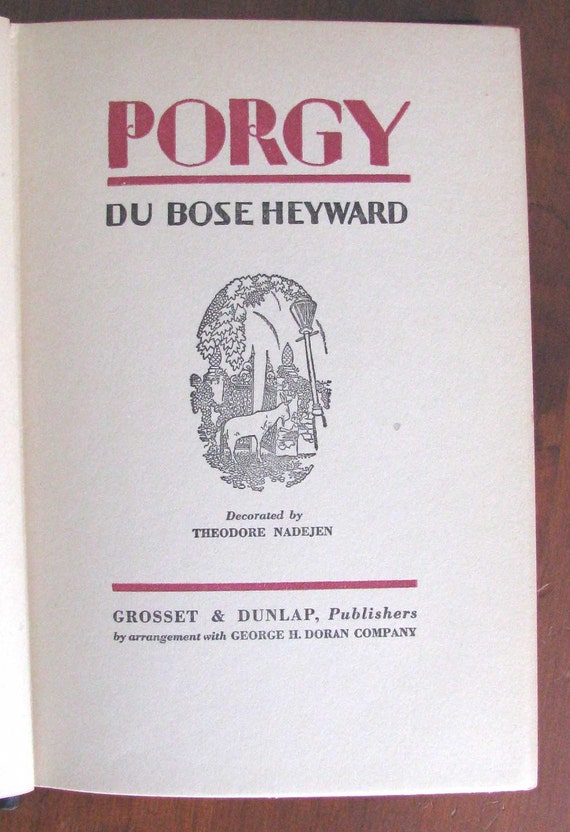
Gershwin's famous opera is based on DuBose Heyward's novel, Porgy, a novel set in 1920s Charleston which traces the lives of poor black Charlestonian's. Neither the play or the opera was performed in Charleston until 1970 because of the racial climate which forbade it.


The main character Porgy is based on the black crippled beggar Sammy Smalls who was arrested in 1924 but later released. I've always been a fan of the songs and overture of Porgy and Bess, which now means more to me having visited and studied the city where it was originally set. And The Jenkins Orphanage Band were the band in Charleston that Heyward describes in his novel (I understand the passage is copyrighted so I cannot produce it here).

I've also just learnt that the song 'Summertime' is actually about the feelings of the survivors from the devastating hurricane of 1911.

After world war one, when the rest of the nation was busy building themselves as modern progressive cities, Charleston was alone in the South for wanting to look backwards and preserve its past. The city has always been proud of its heritage, and is willing to accept, and publicize, the large part it played in the slave trade. Walking past the swaying palmetto trees on the seafront and the rich southern planters homes, and comparing them to the rundown parts of Harleston village and the derelict county jail next to the original home of the orphans, you can almost see Sammy begging on the side of the street with his goat cart, and see the disgust of former slave owners adjusting to a world in which cotton and rice were no longer king.
.

The county jail:


Below: a few examples of southern planter homes


And, seeing as we're talking about Heyward, he is coincidentally a descendant of one of only four South Carolinian signers of the Declaration of Independence (Thomas Heyward Jr.). Joseph and I signed a version of the document in the 'Old Provost and Exchange' building, and also got to dress up, which I suspect was really an activity for small children. So naturally, photographic evidence was needed.


Tuesday, 15 September 2015

Saved from the chain gang

So this post isn't exactly what I said my next post would be (a musical analysis of the Jenkins Orphanage band). This is because I haven't had chance to look at enough to write a blog post on, and because I've been busy with other stuff which I think is allowed.

I start my third year in less than two weeks now, I am so excited to get back to Newcastle and see what's on the horizon for me this term. I love Sheffield but most of my friends have gone back to their own University's now and the city is a bit bleak here at the moment! I am going to be doing a work placement this year in the Great North museum where I already volunteer as a library assistant in their wonderful history collections, and am running the administration side of Journey to Justice (as a temporary role; they were struggling to find someone so I said I would try my best alongside my studies and see how I got on.) I am also the new Academic officer of Newcastle University's History society for 2015/16, which involves being the principle contact between lecturers/staff and the society, and planning academic events and talks.

So I have a few things I'll be balancing this year, but I guess that's normal for me. Anyway, the main aim of the blog is my research, which I have been working hard on for the past few days. Proof of me in action (yes it involves highlighters and a magnifying glass) -


So basically I am currently going through all the newspaper articles/advertisements I printed out in the Library of Congress and Charleston's 'Avery Research Center', and making notes on the main themes, how they present the Jenkins orphanage band, who is writing, etc. I've found some really interesting information which highlights the social and economic climate of the US south at the time, and indeed the poor opportunities and help available for black people.

The collection of newspaper articles I have date between 1895, and 1936, though I am concentrating mainly on the 1890s up until around 1920. It is hard not to get sidetracked to look at later years, when so many of the musicians went on to perform for Count Basie, Duke Ellington, Erskine Hawkins and a score of other famous musicians and bandleaders in the big band era. But  that is a whole other research project (and also the subject of the anthology Dr Karen Chandler at the Avery Research Center is currently writing).

(The Avery Research Center today. This building used to be the Avery Normal Institute, was founded at a similar time to the Jenkins Orphanage and was also a great school that taught many of South Carolina's musicians).

A great many of the articles are advertising concerts the band were performing in, and entry prices to these range from 50c to nothing. The geographical range of these advertisements are huge - from Maine and Massachusetts, down the east coast to Florida, across to Tennessee and even as far west as Utah. I also have a few articles from London, UK. Doubtless the band also visited many other cities I haven't yet found records for. Surprisingly I have found very limited sources from Charleston newspapers. My main knowledge of their focus is from quotes from The Charleston News and Courier printed in other newspapers. The majority of articles that mention the Jenkins orphanage band are from northern newspapers - the economic climate of the south after the Civil War was in very bad shape even after reconstruction, and Jenkins probably took the orphans north because that was where most of the money was.

A common theme across the time period is a plea for money and aid to help the 'little destitute orphans.' Language to shock and encourage people to sympathize with the children's cause was often used, such as in a letter from Reverend Daniel Jenkins himself to a New York newspaper in 1897 which stated 'we must raise the remainder [of the funds needed] or let the children die.' Mentions of starvation and illnesses would doubtless have gotten attention and money from mothers/parents etc and those with money to spare.

Many references to Jenkins having saved children from lives of crime and violence are used, and something I found interesting but perhaps not surprising is that in the few relevant women's magazine articles I have read, the godly work of Jenkins and his charitable and humble personality are emphasized, playing on the contemporary view of women as having voluntary and charitable associations, and as mothers with children's best interests at heart.

The only photographs of Jenkins or black musicians that appear in any of the newspapers are in black publications, as might be expected. The African-American newspapers also make little mention of the race of the band- it is probably presumed by the readers that those discussed are black. Yet nearly all of the newspapers published by white people make it clear that Jenkins is a 'negro' and the children are 'darkies' (Lloyd's Weekly Newspaper, London, England, 8th September, 1895), sometimes pointing these out in the headline to catch people's attention.

Jenkins is throughout all of the newspapers portrayed as a very honest, hard-working and good man. Though in some cases the impression is given, such as in Chicago's The Daily Inter Ocean on the 11th July, 1895, that he is a 'good' black and is improving the view people have of his race. Many references are drawn to the 'betterment of his race', or 'the awful conditions of the colored brother of the south' (The Daily Picayune, New Orleans, 11th June 1897), pointing out that black people in post-reconstruction had a much harder day to day life than white people did.

The band's music is hugely praised, and there are many review articles to be found written by both white and black journalists, documenting the names of items, performers, and crowd impressions of the concerts. They are favorably compared to other 'pickaninny bands', and even the Home for Colored Waif's in New Orleans which Louis Armstrong grew up in.

There is no doubt that the orphanage boys and girls were widely loved and praised throughout America and Europe, which just leaves me with a slightly bittersweet taste in my mouth. It is of course wonderful that these talented black children were so widely accepted and their concerts well attended, and yet their parents and other African Americans were at the same time being penalized, trampled on and ignored, implying that only faith, good Christian charity work as was being provided by Jenkins and his administration, and money, could raise their children up from the bottom of an unequal and unjust society and give them a better life than the alternative of the jail or chain-gang could. The children should not have needed 'saving' in the first place. I would like to think that my conclusion would be otherwise but my research on race relations is telling me that learning music was,intentionally or coincidentally, a way out of the negative connotations of being black, and unfortunately not everyone had that opportunity.

I didn't mean to end on such a pessimistic note! Have a nice photograph of the band, courtesy of the Avery of the Avery Research Center for African American History and Culture, College of Charleston, Charleston, SC (apologies for the quality, it's a photocopy of a photocopy).


Wednesday, 9 September 2015

Showmen

I am so happy to say that I finally have permission to use some of the photographs of the band!

I'm still in the process of gaining permission for one or two of the best ones; and unfortunately I can't get permission for my personal favourite photograph which is very clear, but obviously understandable as the collections at Avery are still largely unprocessed.

Most of the ones I have are undated, and nearly all come from the Charleston Jazz Initiative collections in the College of Charleston (including the one below).

So here is just a taster of one image of the the Jenkins Orphanage Band from the Anglo-American Exposition during 1914...


As is seen here, the conductor was usually always a small boy who often performed tricks such as cartwheels whilst the band played. The band were taught to be great showmen and knew how to attract an audience!

King George V was so impressed with the band that he requested a private concert while they were in London, but unfortunately this had to be called off after Great Britain declared war on Germany.